
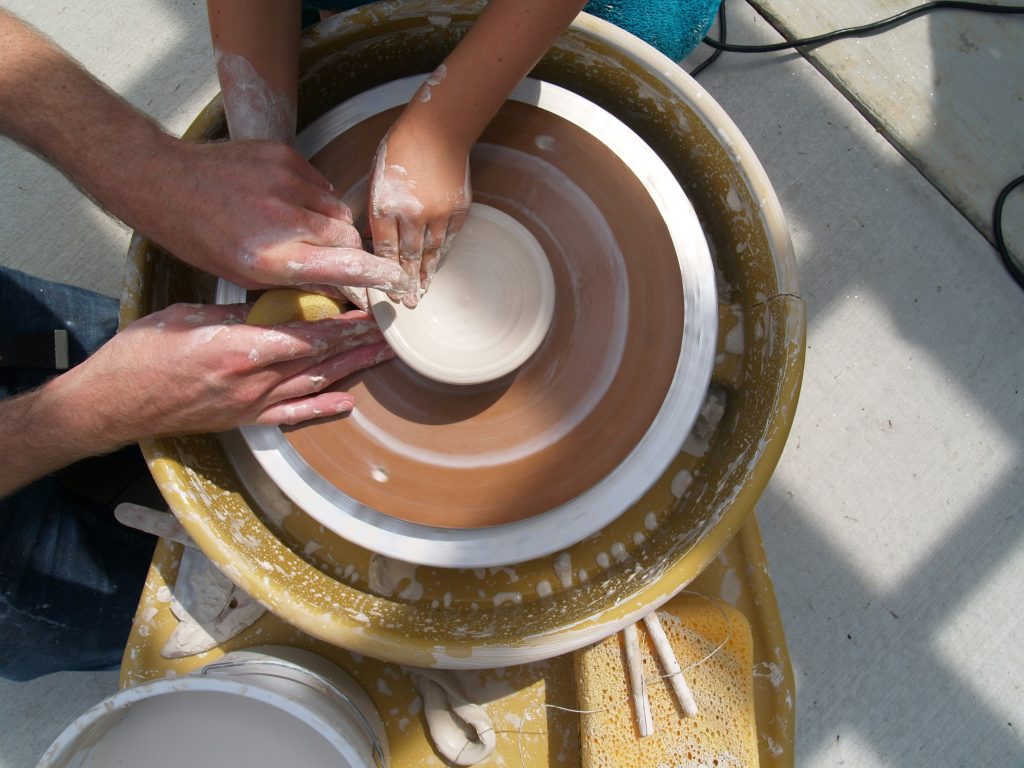
A woman sits at a pottery wheel in the mountains of North Carolina, her phone tucked away somewhere she can’t easily reach. Around her, strangers shape clay, weave baskets, and sketch landscapes. No one is checking emails. No one is talking about quarterly goals. The only deadline is dinner. For many participants at creative wellness retreats like those hosted at Peland School of Craft in Bakersville, North Carolina, that’s exactly the point.
For years, wellness has been packaged as something to optimize. We count our steps, track our sleep, log our workouts, and download apps designed to help us relax. But for many people, especially those who spend their days looking at screens, even self-care has started to feel like another item on a to-do list. Now, a growing number of people are looking for a different kind of reset. Instead of booking luxury spa weekends or silent meditation retreats, they’re signing up for pottery workshops, weaving classes, printmaking sessions, and creative retreats designed around one simple idea: making things can help us slow down. The goal isn’t to create a masterpiece. It’s simply to create.
The Allure of Analog
According to wellness trend forecasting data, interest in analog living continues to grow as people seek experiences that pull them away from screens and reconnect them with physical, hands-on activities. Across the country, pottery studios have wait lists. Book clubs are thriving among young adults thanks to BookTok and Bookstagram. Knitting groups, woodworking classes, and community art workshops are attracting younger generations who grew up online.
The shift reflects something many people are feeling. Life moves fast. Notifications arrive around the clock. Work and home often occupy the same space. Even moments of rest become opportunities for productivity. Creative restoration offers another option. Rather than asking people to do more, it invites them to slow down.
Researchers have long studied how creative activities affect mental well-being. Incorporating the principles of the Expressive Therapies Continuum, studies have found that hands-on creative activities can help reduce stress, improve mood, and increase feelings of focus and engagement by actively stimulating cognitive and emotional processing in the brain. While the science continues to evolve, many people don’t need research to tell them what they already feel when they’re immersed in a project. They know the sensation. Hours disappear while painting. Time slips away while gardening. A knitting project becomes unexpectedly absorbing. The outside world quiets down. For a little while, the only thing that matters is what’s right in front of you.
Restoring Our Fragmented Focus
That feeling sits at the heart of creative restoration retreats. At places like Penland School of Craft, participants spend days learning everything from ceramics and woodworking to photography and textiles. Founded in 1929, the school has become one of the country’s most respected craft education centers, drawing artists, hobbyists, and complete beginners from across the United States. Some attendees arrive with years of experience. Others have never touched a pottery wheel or picked up a carving tool. The common denominator isn’t talent; it’s curiosity.
Imagine spending a morning trying to shape a bowl from clay. It collapses. You start over. Then it collapses again. Normally, failure feels frustrating. In these settings, it’s expected. Environmental psychologists refer to this through Attention Restoration Theory, noting that engaging in these low-pressure, “soft-fascination” tasks gives our brain’s overtaxed executive functions a rare chance to rest and recover. Nobody is grading the final product. Nobody is measuring success. The value comes entirely from the process itself.
That can be surprisingly freeing. Modern life often rewards efficiency, speed, and results. Creative practices operate differently. They require patience, experimentation, and a willingness to make mistakes. A crooked mug, an uneven basket, or a painting that doesn’t look the way you imagined are no longer failures. Instead, participants learn to view them as part of the experience. In many ways, that’s the lesson: not everything has to be perfect to be worthwhile.
Preserving Culture through Conversation
The appeal of creative restoration goes beyond individual wellness. Many retreats also introduce participants to traditional crafts and artistic practices that have been passed down through generations. Across the country, organizations are partnering with local artists and makers to teach skills that might otherwise fade over time. Participants aren’t simply observing these traditions from behind a museum display case; they’re actively engaging with them. They learn where materials come from, hear the stories behind techniques, and discover how creativity has helped communities preserve culture, identity, and history. The result feels less like a class and more like an intimate conversation.
That sense of connection often extends beyond the workshop itself. At many creative retreats, meals are shared around long tables. Participants swap stories about unfinished projects and failed attempts. Friendships form between people who likely never would have met otherwise. Someone might arrive feeling burned out from a demanding corporate job and leave having spent a week learning woodworking alongside a teacher, a retiree, a nurse, and a graphic designer. The common thread isn’t profession or background; it’s the willingness to try something new.
There’s something uniquely disarming about becoming a beginner again. Adults spend much of their lives trying to appear competent. At a creative retreat, everyone starts from the same place. Everyone struggles, everyone asks questions, and everyone makes mistakes. And everyone laughs when things don’t go according to plan. That shared vulnerability creates a different kind of connection than many adults experience in their daily lives. For some participants, the community becomes just as meaningful as the craft itself.
“The goal isn’t to create a masterpiece. It’s simply to create.”
Reversing the Flow
The growing popularity of these retreats also reflects a broader shift in how people think about wellness. For years, self-care was often framed as escape—take a break, disconnect, or step away from the stress. Creative restoration doesn’t necessarily ask people to withdraw from the world. Instead, it asks them to engage with it differently.
Participants notice textures, colors, sounds, the feel of clay between their fingers, the rhythm of a loom, and the smell of fresh sawdust in a woodworking studio. Their attention shifts from consuming information to creating something tangible. And that distinction matters. Many of our daily habits involve taking things in. We scroll through social media feeds, watch videos, answer emails, and react to notifications. Creative activities reverse that pattern. They ask us to contribute something instead, even if nobody ever sees the finished product.
As creative restoration retreats continue to grow, they are reshaping our definition of self-care. The future of wellness may not be found in another app, another tracker, or another productivity strategy. It might look more like a room full of strangers gathered around a table, hands covered in paint or clay, learning to create something slowly. In a world that constantly demands that we move faster, there is something powerful about choosing a different pace.
Creative restoration retreats aren’t really about pottery, weaving, or woodworking. They’re about remembering what it feels like to focus on one thing at a time, to create without pressure, and to connect without distraction. They allow us to leave with something far more meaningful than a souvenir: the reminder that sometimes the best way to recharge isn’t by doing less, but by making something with your own two hands.


